Friday, 2 June 2017

わたしの かぞく My family

We all have family right.
but how we introduce our family in japanese language? Hmmm
No worries minnasan. There is a simple way to introduce your family in japanese language.
You just need to know the right vocab, then everything will be settled.

Family in japanese called kazoku (かぞく)


Some vocabularies i want to share:

My father is chichi (ちち)
Someone's father is otoosan (おとうさん)


My mother is haha (はは)
Someone's mother is okaasan (おかあさん)


My elder brother is ani (あに)
Someone's elder brother is oniisan (おにいさん)
My younger brother is otooto (おとうと)
Someone's younger brother (おとうとさん)


My elder sister is ane (あね)
Someone's elder sister is oneesan (おねえさん)
My younger sister is imooto (いもうと)
Someone's younger sister (いもうとさん)

Now, let me introduce my family ^^,


わたしの かぞくは 6-にん です。
ちちと ははと あねと おとうとと いもうとと わたしです。
ちちの しごとは スーパーバイザーです。
ちちは 54-さいです。

ははは も 54-さい です。
ははの しごとは こうむいん です

あねは 23-さい です 
USIM の がくせい です

おとうとは 14-さいです
ちゃう がくせい です

いもうとは 12-さいです
しゃう がくせい です

わたし 22-さい です
USIM の がくせい です。

いじょ です。

Doozo yoroshiku ! どうぞ よろしく !

Ha ha ha. I think at the earliest post i have done a little bit introduction about myself, right.
But never mind, i will do it again in this post. I will do a proper introduction of myself as i have learnt on my previous class on how to introduce ourselves in japanese language.

はじめまして。

おなまえわ アキラ です。

マレ₋シアから きました 

USIM の がくせい です

りがくぶの 3-ねんせいです

どうぞ よろしく、おねがい します。

Hajimemashite.

Onamae wa akira desu

Mareeshia kara desu

USIM no gakusee desu

Rigakubu no san nensei desu

doozo yoroshiku onegai shimasu.


* you may use hajimemashite to introduce yourselves to people who you just met
*then after introduce yourselves you should politely ended with doozo yoroshiku which means nice to meet you.


Thursday, 1 June 2017

Hiragana, Katakana, Kanji


(T_T) how i'm going to memorize all those syllables

Btw, to understand japanese language, we should master hiragana and katakana writing.

Hiragana is used for japanese words while katakana is used for newer word that imported from western countries.

This is hiragana syllables :


This is katakana syllables looked like:


I learnt some kanjis also *flip hair*
but later haha.

At first i found it difficult to differentiate which one is hiraganas' characters and which one is katakanas.
You will not find it confusing if you only memorize the hiraganas. But soon, after you memorize the katakanas, you will. Trust me. If you do a lot of  practise on writing katakanas and hiraganas, you wont find it confusing. Like the pro said, practices makes perfect.

Dont worry minnasan,
like the ghost said, we'll work through this together.
Everything will be easy after a hard practice.
Ganbatte kudasai minnasan ! and to me especially (phewww, a lot of work need to be done!)

Ijo desu


'kiritsu' (きりつ), 'rei'(れい), 'chakuseki'(ちゃくせき)

During our primary and secondary school,
We, Malaysian, used to say  stand up, then ' ASSALAMUALAIKUM, SELAMAT PAGI, CIKGU'.
Then, all of us will sit after the teacher saying ' duduk, semua'.
Its kind of a norm expression or greetings we use in a classroom.

but, do  japanese people use the same greetings and expressions like we normally say and do in Malaysia?

Certainly not. They have their bow to show respect to the sensei(the teacher). We dont do the bow part. Its enough to show your respect by attentively greeting the teacher.

How the japanese people greet their せんせい (sensei) or きょうし (kyooshi).

Zoraida sensei (my japanese language sensei) did taught us how to say stand up and sit in japanese language.

To say stand up, 'kiritsu' (きりつ).
The class rep will say 'kiritsu'
after all of us stand up, we do the bow part to show a respect to the teacher.
Btw, japanese culture, they dont do to the teacher only.
If they want to greet people, they make a must to do the bow part.
after the 'rei', the class rep will say ohayoo gozaimasu, sensei.
then everyone will follow.
Then the class rep will say  'chakuseki'(ちゃくせき) which means sit down.

The pronunciation of the words haha really captured my heart because the sounds uttered looked so cute. But, i found it difficult to pronounce kiritsu haha. Because i have problem to pronounce word with 'r'.

'rei'(れい), eego de 'bow' desu yo


Japanese have 3 types of bows depending on the deepness of the waist bend


Eshaku bow
(the most casual bow)
You need to bend your waist about 15 degree angle
The japanese people tend to give this bow when exchanging a casual greeting or passing by someone of a higher social status.

Keirei bow
(normally known as business interaction bow)
We need to bend our body part to about 30 degrees.
The keirei bow is normally practised when entering or leaving reception or meeting room
or when greeting customers.

Saikeirei bow
(the most polite bow)
We need to bend our upper body part (torso) about 45 degrees.
This bow used to express feelings of deep gratitude or apology

Last but not least is ' Acuh tak Acuh ' bow
haha just kidding. Japanese dont have that bow.
Only we malaysians do that bow sometimes. (I'm referring to me haha..as before i want to do bow exactly like the japanese people do but i dont how to do a proper bow, so i just nod my head a little bit and i was like, waaa! i have done my bow perfectly)

During that class, i also learnt about the classroom expression.

If your sensei are explaining the lesson and you are not listening well,
we can say moo ichido onegaishimasu.
It means one more time please
I suggest you to memorize this phrases well if you are deciding to take japanese language course haha
It is the most important phrase you should remember compared other words.
For us that have zero basic in japanese language, it may be difficult to capture and understand the words right away, so we may use the もういちど(informal) or もういちど おねがいします.
If you're running out words or vocabulary in japanese class, just say that phrase please.

some phrases that you can combine with moo ichido :

Kiite kudasai (きいて ください) : please listen
Kaite kudasai (かいて ください) : please write
Itte kudasai (いって ください) : please talk
Mite kudasai (みて ください) : please see
Yonde kudasai (よんで ください) : please read

We may combine the phrases like this

E.g : Moo ichido itte kudasai ( please repeat your word one more time)

and how do we say if we understood what sensei's explaining.

We say wakarimashita but if we didnt understand, say wakarimasen

Btw, lets imagine
after we understood the lesson,
we need to excuse ourselves, how can we say to sensei to excuse ourselves?

we may say chotto shitsureeshimasu (ちょっと しつれします)

Instead of the lesson in the class, i also see this link to increase my vocabulary
https://www.youtube.com/watch?v=qAnUn4p_wbk  and this https://www.youtube.com/watch?v=EeeUjjyqT1Q

Ijo desu ;)

Treat Me right, please.

1549 p.m
21022017

Before, I used to bear in my mind : to treat her/him right if he/she treats me right.
Haha*devil's laugh*
In Islam and japanese culture, its totally wrong to do that.

For the first lesson of the second class, we learn to politely greet people.
In japanese culture, it is a norm practice to politely greet people even though to a stranger
and at the first place, Islam also encourages us to greet any people with dua'a (Assalam)

We, Malaysians, have formal and informal greetings, right?. So it is the same with the japanese.
Japanese people greet accordingly to the occasion and time.

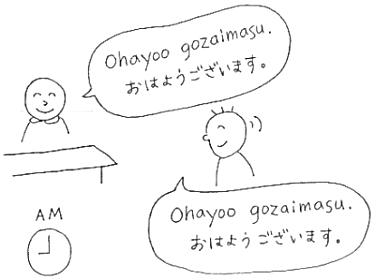
In the morning,


Ohayoo gozaimasu means good morning.

You may say Ohayoo (informal), Ohayoo gozaimasu (formal) to greet people in the morning.
The second party will answer back ohayoo gozaimasu indeed.

In the afternoon,


You can say konnichiwa and reply back konnichiwa. If you want to say HELLO, instead of hello, you may say konnichiwa also.

In the night, when you want to greet people before the time to sleep,


In the night, when you want to greet people before YOU'RE GOING TO SLEEP


Sounds interesting right, haha. Japanese have two night greetings but bring different meaning.

When you want to say goodbye,

You can say さよなら (sayoonara) and reply back dewa mata or じゃあまた (jaa, mata)。


When you want say thank you,


You can say ありがとうございます (arigato gozaimasu)(formal)。And you can reply back いいえ(iie) or すみません (sumimasen).

When you want to say sorry or excuse me,


You can utter すみません (sumimasen). 

Other basic greetings : I learnt other basic greetings through this link :Another basic greetings 

いじょです。

Wednesday, 8 March 2017

Konnichiwa

こんいちは
konnichiwa

Hajimemashite.


Indeed, the journey towards self-development will never be easy but it will be worth it.
And I'm at the path of self-improvement.
This 22 year old student is trying to improve herself by learning and exploring different language and culture.
One has said to have another language is to posses a second soul
So, this student decided to learn a foreign language which is meant to be the japanese language, to see and experience a different perspective of life

Watashi no namae wa Akira desu

Watashi wa Malaysia jin desu !

This semester i'm taking japanese course (BJA 2012)
I choose to take this course because i do really want to speak and understand this language very well

and i really hope this course will be good to me *sigh*


dont misunderstand me! I do really love japanese language as much as i love and enjoy to watch their animes but still i find out it difficult for me to excel this course triumphantly

Like dis cutie penguin,

I'm looking forward to do well in this course so do wish me luck, please! *bow*

1012 a.m.
14022017